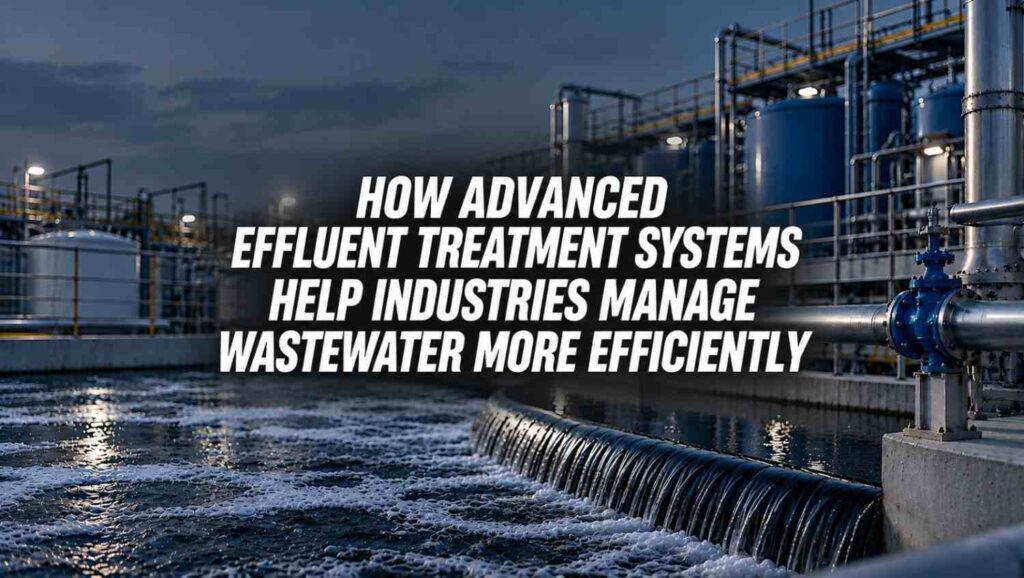
Industrial wastewater is becoming more than an environmental management issue. For businesses operating in the UAE, it can directly affect operating costs, water consumption, regulatory compliance and long-term resource efficiency. As industries expand and wastewater streams become more complex, conventional treatment processes may not always provide the quality required for discharge or reuse.
This is where an Effluent Water Treatment & Recycling System can provide a more comprehensive approach. By combining physical, chemical, biological and membrane-based processes, advanced treatment systems can help industries remove difficult contaminants, improve treated-water quality and create opportunities for responsible water reuse.
The UAE’s Water Security Strategy 2036 targets increasing the reuse of treated water to 95%, highlighting the growing importance of efficient wastewater treatment and reuse across the country.
What Makes an Effluent Treatment System Advanced?
Traditional wastewater treatment generally focuses on removing suspended solids and biodegradable organic matter. Advanced effluent treatment goes further by adding treatment stages designed for specific contaminants and reuse requirements.
Depending on the wastewater characteristics and required output quality, an advanced system may combine biological treatment, membrane filtration, activated carbon, chemical treatment, advanced oxidation, reverse osmosis and disinfection.
The system should be engineered around the wastewater composition, flow variation, treatment objective and intended use of the treated water.
Advanced Technologies Improve Treatment Efficiency
Membrane Filtration for Higher-Quality Effluent
Membrane technologies such as ultrafiltration (UF), nanofiltration (NF) and reverse osmosis (RO) provide additional barriers for suspended solids, dissolved contaminants and salts.
For industrial applications requiring high-quality reuse water, membrane treatment can be integrated after biological or physical treatment. This helps create a more controlled water-quality output while reducing the contaminant load reaching downstream processes.
Biological Treatment for Organic Waste
Biological processes use microorganisms to break down biodegradable organic matter and reduce parameters such as BOD and COD.
Technologies such as MBBR, SBR and MBR can be selected according to the wastewater characteristics and operational requirements. MBBR provides a compact biological treatment approach, while MBR combines biological treatment with membrane separation to produce high-quality treated effluent.
Chemical and Advanced Treatment for Difficult Contaminants
Some industrial wastewater streams contain contaminants that conventional biological treatment cannot adequately remove. Depending on the application, coagulation, chemical precipitation, adsorption, ion exchange or advanced oxidation processes (AOPs) may be introduced.
AOP technologies using processes such as ozone or UV-based oxidation can be considered for certain persistent organic compounds, colour and other difficult-to-treat contaminants. The appropriate technology depends on laboratory testing and wastewater characterisation rather than simply selecting the most advanced technology available.
How Do Advanced Systems Support Water Recycling?
One of the biggest advantages of advanced treatment is the potential to move from a treat-and-discharge model toward treat-and-reuse.
Depending on the quality achieved and the applicable requirements, treated effluent may be considered for applications such as:
- Cooling and utility processes
- Equipment or floor washing
- Landscaping and irrigation
- Process water applications
- Other approved non-potable uses
The required treatment level depends heavily on the intended reuse application. Producing water for irrigation, for example, may require a different treatment approach from producing high-quality process water.
UAE Regulations Make Treatment Design Especially Important
Industrial wastewater management in the UAE is governed by both federal requirements and emirate-level frameworks. Federal Cabinet Resolution No. 39 of 2021 provides the executive regulations associated with Federal Law No. 12 of 2018 concerning integrated waste management.
Requirements can also vary according to the emirate, discharge route and intended reuse. In Abu Dhabi, for example, the Department of Energy’s Trade Effluent Control Regulations 2022 establish a regulatory framework for the safe and economical management of trade effluent. This makes wastewater characterisation, process design, monitoring and documentation important parts of an industrial treatment strategy.
Efficiency Is More Than Removing Contaminants
A well-engineered Effluent Water Treatment & Recycling System should be assessed not only by removal performance but also by its overall operating efficiency.
Key factors include:
- Energy consumption
- Chemical dosing
- Sludge generation
- Membrane fouling
- Water recovery
- Equipment reliability
- Maintenance requirements
- Operator requirements
Modern plants can also incorporate SCADA, online sensors and automated controls to monitor parameters such as flow, pH, conductivity and turbidity. Better process visibility can help operators identify abnormal conditions earlier and make informed adjustments.
Conclusion
Advanced effluent treatment is no longer simply about meeting discharge requirements. For UAE industries, it can become part of a broader strategy for water conservation, operational efficiency, compliance and resource recovery.
An appropriately designed Effluent Water Treatment & Recycling System can combine biological treatment, filtration, membranes and other specialised technologies to address complex wastewater challenges and create opportunities for water reuse.
The best results come from a site-specific approach: analyse the wastewater, define the intended treated-water quality, select the appropriate treatment technologies and support the system with consistent monitoring and maintenance. This helps industries build wastewater infrastructure that is not only compliant, but also more reliable and better aligned with long-term water-management goals.
Need a More Efficient Effluent Treatment Solution?
WET provides engineering, treatment and maintenance support for industrial water and wastewater systems, helping businesses improve treatment performance, reliability and resource efficiency.
📧 Email: sales@wet-fzc.com
📞 Contact: +971 6 557 8230
Talk to WET’s technical team to explore an effluent treatment and recycling approach suited to your wastewater characteristics and operational requirements.





Leave A Comment